The cost of selling a house is usually about 8% to 10% of the sale price, and can pass 10% once you add prep, repairs and moving. Here is every category, line by line.
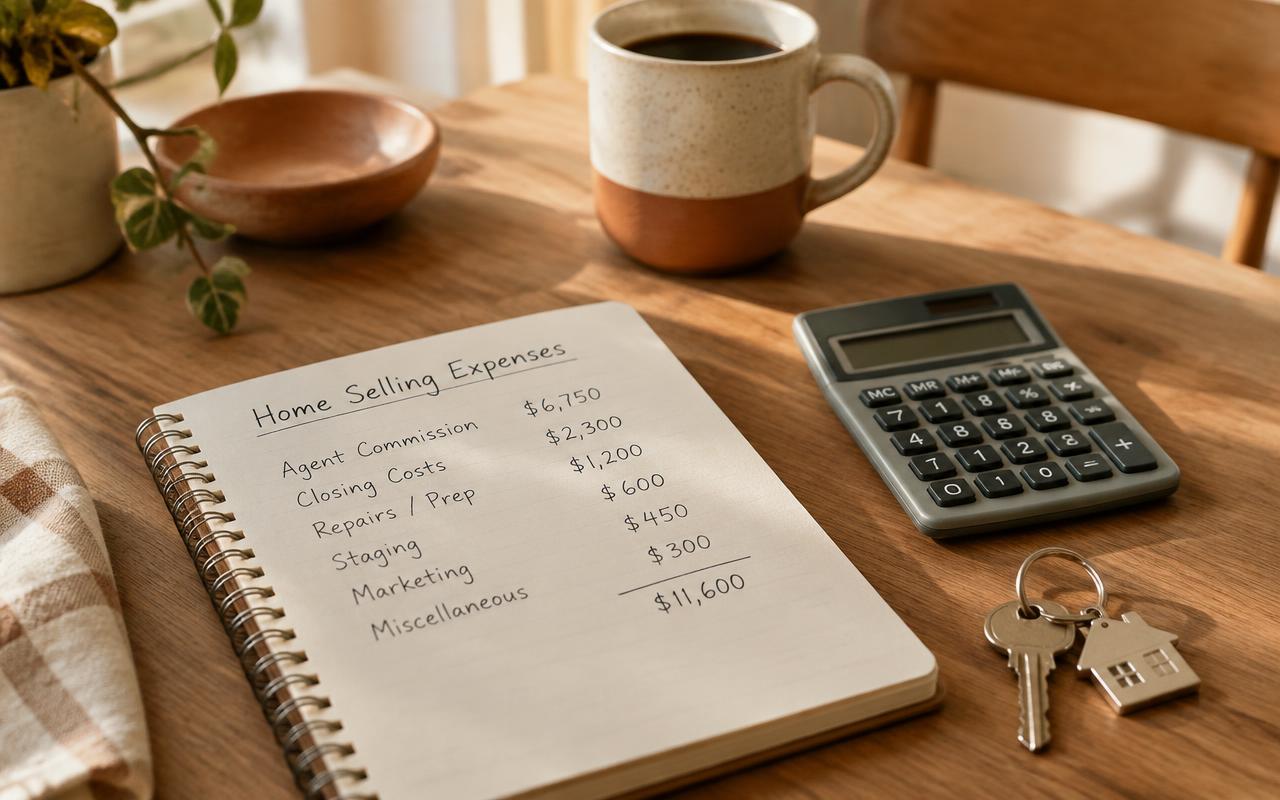
The cost of selling a house is usually about 8% to 10% of the sale price, and can pass 10% once you add prep, repairs and moving. On a $400,000 home, that's roughly $32,000 to $44,000. The largest piece is agent commission (about 5-6%), followed by closing costs (about 1-3%), then getting-ready costs, carrying costs while the home sits, and moving. Selling for cash removes most of these, usually in exchange for a lower price. Below is the full breakdown, line by line.
The full breakdown, at a glance
Here is every category of cost, with typical ranges and what each looks like on a $400,000 sale. Your actual numbers depend on your state, your commission arrangement and your home's condition.
| Cost category | Typical range | On a $400,000 sale |
|---|---|---|
| Agent commission | 5-6% of price | $20,000 - $24,000 |
| Seller closing costs | 1-3% of price | $4,000 - $12,000 |
| Pre-sale prep and repairs | Varies | $1,000 - $8,000+ |
| Staging, cleaning, photos | Varies | $500 - $3,000 |
| Carrying costs while listed | Per month it sits | $1,500 - $3,000+ / mo |
| Buyer concessions | 0-2%+ (market-dependent) | $0 - $8,000+ |
| Moving | Local vs long-distance | $1,000 - $5,000+ |
| All-in (typical) | ~8-10%+ | ~$32,000 - $44,000 |
1. Agent commission
The biggest cost by far. Historically 5-6% of the sale price, and more openly negotiable since the 2024 industry settlement, which also means the buyer's agent fee is now negotiated separately rather than assumed. On a $400,000 home this single line is $20,000-$24,000, usually larger than every other selling cost combined, and the main reason a cash sale can compete even at a lower price.
2. Closing costs
The fees settled on closing day: the transfer or conveyance tax (state-specific, about 0.456% in Massachusetts, roughly 1-1.25% in Connecticut), owner's title, attorney or settlement fees, recording fees and prorated property taxes. Together they usually run 1-3% of the price. For the line-by-line detail, see our dedicated guide to seller closing costs.
3. Getting the home ready
To sell on the open market for top dollar, most homes need some preparation: pre-listing repairs a buyer's inspector or lender would flag, plus cleaning, painting, minor updates, staging and professional photos. This ranges from a few hundred dollars to many thousands depending on condition. A home that needs major work is where these costs climb fast, and where sellers often start comparing a listing against a straight cash sale.
4. Carrying costs while it sits
Every month your home is on the market, you keep paying the mortgage, property taxes, insurance and utilities. In a fast market that's a few weeks; in a slow one it can be months. Time-to-sell is a real cost, not just an inconvenience, and it's the cost a quick cash close removes almost entirely.
5. Concessions and at-the-table extras
Two more that catch sellers out. Buyer concessions, credits toward repairs or the buyer's closing costs, are common when the market softens and can add 1-2% or more. Some sellers also offer a home warranty to sweeten a deal. These are negotiable and depend on how much leverage the market gives you.
6. Moving
Easy to forget in the math: a local move might run $1,000-$2,000, a long-distance one several thousand, plus deposits, overlap costs and the odd storage month. It's the last line, but it's real money out of the same pot.
Cash and listing have different cost profiles
A cash sale strips out most of this list: typically no commission, no prep or repairs, minimal closing costs, and a close in days, so carrying costs nearly vanish. The trade-off is the price, since a cash offer is generally below full retail because the buyer takes on the repairs, the risk and the speed. So "which costs less to sell" is the wrong question. The right one is what you actually keep on each path, net of every cost above.
What it all comes down to: your net proceeds
Add up the costs, subtract them and your remaining mortgage from the sale price, and you have your net proceeds, the money that actually reaches you. That single number, not the sale price, is what's worth comparing between selling for cash and listing with an agent.
Enter your address and PropVio estimates your value, then shows your net walk-away for a listing and for a cash sale, with these costs already folded in. If you decide to move forward, PropVio connects you with a licensed local agent or a local cash buyer, and if listing is the better number, it'll tell you.
Common questions
What is the total cost of selling a house?
+
Usually about 8% to 10% of the sale price all in, and sometimes more once prep, repairs and moving are included. On a $400,000 home that's roughly $32,000 to $44,000, most of it agent commission.
What are the biggest costs of selling a home?
+
Agent commission is by far the largest (5-6%), followed by closing costs (1-3%), then getting-ready costs and the carrying costs of however long the home sits on the market.
How can I reduce the cost of selling my house?
+
Negotiate the commission, do only the prep that pays for itself, price to sell quickly so carrying costs stay low, and compare a listing against a cash sale (which removes commission and most prep) to see which nets more.
Do sellers pay closing costs?
+
Yes, sellers typically pay 1-3% in closing costs on top of commission, including transfer or conveyance tax, title, attorney and recording fees. See our seller closing costs guide for the full list.
What does it cost to sell a house for cash?
+
Very little in fees, usually no commission, no prep and minimal closing costs, with a fast close that cuts carrying costs. The cost shows up in the price instead, since a cash offer is typically below full market value. Compare the net walk-away, not the fees.
How do I calculate my net proceeds from selling?
+
Take your expected sale price, subtract commission, closing costs, prep, concessions and moving, then subtract your remaining mortgage. What's left is your net proceeds, and a home sale calculator does it in a couple of minutes.
Selling a house usually costs about 8% to 10% of the sale price. On a $400,000 home, that's roughly $32,000 to $40,000, most of it agent commission, plus closing costs, prep, concessions and moving on top.
Home value estimators are usually accurate within a few percent for homes currently listed for sale, but the error is much larger for off-market homes, commonly around 7% or more. They're a useful starting point, not a final answer.
Listing with a realtor usually nets you more money if your home is in good shape and you can wait a couple of months for the sale to close. A cash offer almost always looks lower on paper, but once you subtract agent commission, repairs, closing costs and the months of carrying costs a listed home racks up, the gap narrows.
Market value is what a buyer will actually pay for your home in today's market. An appraisal is a licensed appraiser's professional opinion of that value, usually ordered by the buyer's lender to make sure the loan isn't larger than the home is worth.
Location, size and layout, age and condition, updates, the local market and recent comparable sales are what move your home's value. Location is the biggest factor and the one you can't change; condition and updates are the ones you can.
Seller closing costs are the fees paid to complete a home sale, and they usually run about 1% to 3% of the sale price, or roughly 6% to 10% once agent commission is included.