On a $400,000 property, total selling costs routinely run $30,000 to $40,000 once every line item is counted. Here's every common seller expense, the net proceeds math, and where you can negotiate.
Seller costs typically total 8% to 10% of the sale price once commissions, title fees, transfer taxes, prorated obligations and buyer concessions are counted. On a $400,000 property, that routinely means $30,000 to $40,000. A cash sale removes some of those costs but usually comes at a lower price, so the only honest comparison is your net proceeds on each path.
Most sellers spend weeks focused on their list price and almost no time on what they'll actually keep. The gap between the number on the sign and the number on the wire transfer is where the real surprise happens, and it's a meaningful share of your equity.
There are two main paths sellers consider: listing with an agent or accepting a cash offer from a buyer or investor. Both carry costs. The mix is different, but neither is free. By the end of this guide you'll know every common seller expense, how to run the net proceeds math yourself, and where you have room to negotiate before you sign anything.
What are seller costs when selling a home?
Seller closing costs fall into four buckets: agent compensation, closing and settlement fees, property-related obligations, and buyer credits. Most sellers only think about commissions. The other three buckets can add up to $10,000 or more before a single dollar goes to an agent.
Agent commissions: still the largest line item
Nationally, real estate commissions average 5.5% to 5.7% of the sale price in 2026. On a $400,000 property, that's roughly $22,000 to $22,800, typically split between the listing agent and the buyer's agent at around 2.5% to 3% each. These rates are not fixed by law. They are negotiable, and your leverage increases if the property is move-in ready, priced competitively, or you're interviewing multiple agents before signing.
Title, escrow and settlement fees
Title insurance for the buyer typically runs $500 to $2,000 depending on your state and sale price. Escrow or settlement fees add another $350 to $700 in most markets. Recording fees are smaller, usually $50 to $250, but they still show up on your closing statement. Whether the seller or buyer covers each item varies by local custom, so don't assume the buyer handles them in your market.
Transfer taxes, mortgage payoff and prorated costs
Transfer taxes range from zero in some states to over 2% of the sale price in others. Washington, New Jersey, Connecticut, New York and Pennsylvania consistently rank among the most expensive. Your mortgage payoff is not your current balance: the lender's formal payoff figure includes accrued interest and applicable fees and changes daily, so get the official quote close to closing. Property taxes and HOA dues are prorated to the closing date, showing up as debits or credits depending on your local tax cycle.
How these deductions add up in real dollars
Percentages are abstract. Dollars are what matter when you're planning a move, paying off debt or working out what you can put toward the next purchase.
What the numbers look like on a $400K and $500K sale
On a $400,000 property, closing fees excluding commissions average $4,000 to $12,000 depending on state transfer taxes, title customs and whether you pay attorney fees. Add a 5.7% commission and the total climbs to $26,800 to $34,800, before any buyer concessions. On a $500,000 sale, commission alone at 5.5% runs $27,500, with closing fees adding another $4,500 to $10,000. You can be over $37,000 in total costs before a single repair credit.
Why buyer concessions push the number even higher
In 2026, roughly 45% of sales included a seller concession, with the average request running 1.5% to 3% of the sale price. On a $400,000 property, a 3% concession is $12,000 off the top, reducing your net proceeds dollar for dollar. Most sellers don't factor concessions into early planning, so their actual walk-away is lower than expected, often by tens of thousands of dollars. Budget for it before you list.
From sale price to walk-away: calculating your net proceeds
The math isn't complicated once every variable is in front of you. The two that most often catch sellers off guard are the mortgage payoff and the transfer tax.
The formula every seller should use
Net proceeds = sale price − mortgage payoff − commissions − prorated taxes − closing fees − seller credits. Your mortgage payoff needs a formal quote from your lender, not a glance at your statement, and your transfer tax can swing from zero to several thousand dollars depending on your county.
A sample worksheet with real numbers
Take a $500,000 sale with a $300,000 mortgage payoff. Subtract a 5.5% commission ($27,500), $3,000 in prorated property taxes, $4,500 in title and escrow fees and a $2,000 buyer credit. That leaves about $163,000 in net proceeds, or 32.6% of the sale price.
| Line item | Amount |
|---|---|
| Sale price | $500,000 |
| Mortgage payoff | −$300,000 |
| Commissions (5.5%) | −$27,500 |
| Prorated property taxes | −$3,000 |
| Title, escrow and recording fees | −$4,500 |
| Seller credit to buyer | −$2,000 |
| Estimated net proceeds | $163,000 |
Cash offer vs traditional listing: where the costs split
The right path depends on your timeline, your property's condition and how the net proceeds compare once every cost is on the table. What looks better on the surface often looks different once every line item is visible.
What a cash sale eliminates and what it doesn't
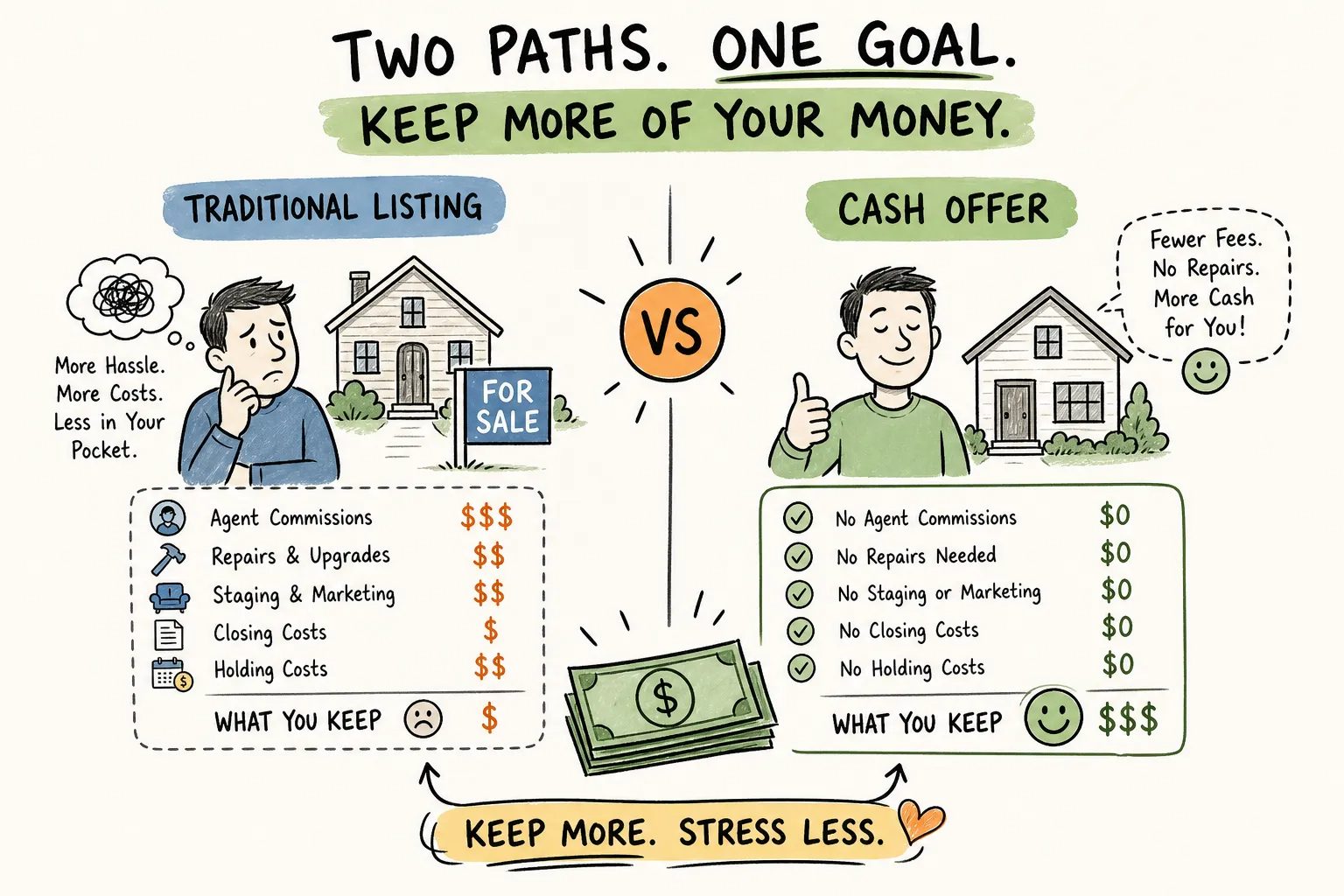
A cash buyer doesn't need a mortgage, which removes the lender-driven appraisal and can shorten the timeline to days or weeks instead of 30 to 60 days. Many direct cash transactions also bypass agent commissions. Title and escrow fees still apply, though they may be lower depending on local practice. The primary cost of a cash sale is the price itself, which typically runs 9% to 11% below what a financed buyer might pay in a competitive listing. On a $400,000 property, that's a $36,000 to $44,000 discount off the gross price, and the variance depends on whether the buyer is an iBuyer, institutional investor or individual.
When each path actually saves you more
A traditional listing maximizes gross price in most markets but adds 8% to 10% in total costs: commissions, closing fees, concessions and pre-listing repairs. For a property that needs $15,000 in work before it lists, a cash offer requiring no repairs and no agent fees can produce a net figure closer than it first appears.
For sellers facing financial difficulty, navigating a divorce or closing remotely on an inherited property, the simplicity of a cash sale carries real value that doesn't show up in a spreadsheet. Running both scenarios with actual numbers, not assumptions, is the only honest way to know which path serves you better.
Practical ways to cut what you spend before closing
What's negotiable and what isn't
Agent commissions are negotiable. The national average is a benchmark, not a rule. Interview at least three agents, compare their marketing plans alongside their rates, and make a specific ask: "Given the condition and location of the property, would you work at X%?" Title insurance rates are regulated in some states but can be shopped in others. Transfer taxes are set by law. Repair credits can be countered after inspection, but overplaying that negotiation can lose the deal.
Timing and preparation moves that protect your proceeds
Addressing cosmetic issues before listing reduces a buyer's leverage to request repair credits. Accurate pricing from the start reduces days on market, carrying costs and the likelihood of a price cut under pressure. Selling in spring and summer in most U.S. markets can also reduce concession pressure.
Pre-listing repairs in the $3,000 to $5,000 range can sometimes head off inspection credit requests two to three times that size. Run the scenario math before deciding what to fix and what to leave.
See your walk-away number before you decide
Many sellers don't know their real net proceeds until the day before closing, after the listing agreement is signed and the movers are booked. That's backwards.
PropVio's assistant, Aria, asks for your address and a few straightforward questions about your property, then shows estimated net proceeds for a cash sale and for a listing with an agent, with seller costs itemized. They're separate journeys: explore one or both, free and with no obligation. Estimates are informational, not appraisals or binding offers.
Enter your address to see your estimated walk-away for a cash sale and for a listing, with every deduction spelled out.
The bottom line
Seller costs typically total 8% to 10% of the sale price. Run the net proceeds formula with your actual mortgage payoff, local transfer tax rate and a realistic concession estimate, and compare the cash and listing paths using the same method. Knowing that before you decide is the only position worth being in.
Common questions
What are seller costs when selling a home?
+
Agent commissions, title, escrow and settlement fees, transfer taxes, prorated property taxes and HOA dues, and any buyer concessions. Together they typically total 8% to 10% of the sale price.
How much are total selling costs on a $400,000 property?
+
Routinely $30,000 to $40,000 once commission, closing fees and concessions are counted. Your figure depends on your state's transfer tax, local title customs and what you negotiate.
How do I calculate my net proceeds?
+
Sale price minus mortgage payoff, commissions, prorated taxes, closing fees and seller credits. Use your lender's formal payoff quote rather than your statement balance.
Does a cash offer save money compared with listing?
+
A cash sale often avoids commissions, repairs and some concessions, but the price is typically 9% to 11% below a competitive financed sale. Compare net proceeds on both paths for your specific property.
Which seller costs are negotiable?
+
Agent commissions and repair credits are negotiable, and title insurance can be shopped in some states. Transfer taxes are set by law and can't be negotiated.
You can sell without a listing agent by handling the sale yourself or selling directly to a cash buyer. The important question is what you keep after costs—not just the commission you avoid.
Selling a house usually costs about 8% to 10% of the sale price. On a $400,000 home, that's roughly $32,000 to $40,000, most of it agent commission, plus closing costs, prep, concessions and moving on top.
Home value estimators are usually accurate within a few percent for homes currently listed for sale, but the error is much larger for off-market homes, commonly around 7% or more. They're a useful starting point, not a final answer.
Listing with a realtor usually nets you more money if your home is in good shape and you can wait a couple of months for the sale to close. A cash offer almost always looks lower on paper, but once you subtract agent commission, repairs, closing costs and the months of carrying costs a listed home racks up, the gap narrows.
Market value is what a buyer will actually pay for your home in today's market. An appraisal is a licensed appraiser's professional opinion of that value, usually ordered by the buyer's lender to make sure the loan isn't larger than the home is worth.
Location, size and layout, age and condition, updates, the local market and recent comparable sales are what move your home's value. Location is the biggest factor and the one you can't change; condition and updates are the ones you can.
Seller closing costs are the fees paid to complete a home sale, and they usually run about 1% to 3% of the sale price, or roughly 6% to 10% once agent commission is included.
The cost of selling a house is usually about 8% to 10% of the sale price, and can pass 10% once you add prep, repairs and moving. Here is every category, line by line.
Your net proceeds are the money you actually keep after selling costs and your mortgage payoff. Here is the formula, a sample seller net sheet, and a faster way to estimate yours.